
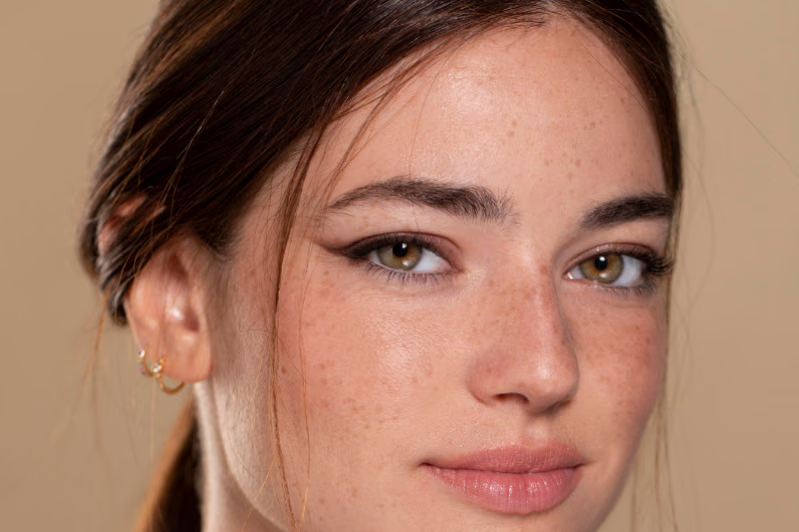
Closed rhinoplasty reshapes the nose through incisions placed entirely inside the nostrils. Because the columella — the skin bridge between the nostrils — is left untouched, there is no external scar.
This page explains what closed rhinoplasty is, who it may suit, how the operation is carried out and how recovery progresses. It also outlines how patients travelling to Izmir usually plan the process. Whether the technique is right for you can only be decided after an in-person examination.
What is closed rhinoplasty?
Rhinoplasty reshapes the bony and cartilaginous framework of the nose. "Closed", or endonasal, means that the surgeon reaches this framework through incisions hidden inside the nostrils.
Through these incisions the dorsal hump can be reduced, the bridge narrowed, the nasal bones repositioned and the tip refined.
| Feature | Closed rhinoplasty |
|---|---|
| Incisions | Inside the nostrils |
| External scar | None |
| Surgical view | Limited; the surgeon works by feel and with endoscopic control |
| Tissue trauma | Comparatively less |
| Resolution of swelling | Often earlier than with the open technique |
| Typical indications | Dorsal hump, bridge refinement, moderate tip changes |
Who is a candidate?
The closed technique is often chosen when the main concern is the bridge — a hump or a wide dorsum — and the tip does not need extensive restructuring.
Points considered at the consultation include:
- Completed nasal growth (usually after 17–18 years of age)
- General health suitable for general anaesthesia
- Willingness to stop smoking before and after surgery
- Expectations that fit the existing structure of the nose
- No previous nasal surgery, or a previous operation that left a framework suitable for the closed approach
In the following situations open rhinoplasty may be preferred:
| Situation | Reason |
|---|---|
| Marked tip asymmetry | The tip cartilages need to be seen directly |
| Severely crooked nose | Extensive cartilage work and grafts may be required |
| Extensive revision | The surgeon must see what the previous operation left behind |
| Thick, heavy tip skin | Support grafts are more often needed |
How is the operation performed?
Closed rhinoplasty is carried out under general anaesthesia in an operating theatre. It usually takes 1.5–2.5 hours, depending on what is planned.
- Incisions are made inside the nostrils along the junction of the cartilages.
- Exposure: the skin and soft tissue are gently lifted off the bone and cartilage framework.
- The bridge: the hump, if present, is reduced in its bony and cartilaginous parts.
- Osteotomies: if the bridge has been opened or is wide, the nasal bones are narrowed and repositioned — with conventional instruments or a piezo device.
- The tip is refined with sutures where necessary.
- The airway: a deviated septum or enlarged turbinates are corrected in the same session.
- Closure: the incisions are closed with dissolving sutures and a splint is applied.
Most patients go home the same day or the following morning.
How does it differ from the open technique?
The essential difference is whether the columella is incised. Systematic reviews report that, with appropriate patient selection, both techniques achieve comparable aesthetic and functional results; the choice depends on the anatomy and the surgical plan.
| Criterion | Closed | Open |
|---|---|---|
| Columellar incision | None | Yes, leaves a small scar |
| Control over tip cartilages | Limited | Direct view |
| Operating time | Usually shorter | Usually longer |
| Tip swelling | Often resolves earlier | May take longer |
| Complex correction and grafting | Limited | More suitable |
Planning a visit from abroad
Many patients come to Izmir from other countries. A typical timeline:
| Step | When | What happens |
|---|---|---|
| First contact | Weeks before | Photographs and a short history are shared by e-mail or WhatsApp; a preliminary opinion is given |
| Arrival and consultation | 1 – 2 days before surgery | In-person examination, endoscopy, photographs, final plan and informed consent |
| Surgery | Day 0 | General anaesthesia; discharge the same day or next morning |
| Follow-up | Days 1 – 7 | Wound checks; splint removal around day 5–7 |
| Departure | Day 6 – 8 | Flying is usually possible after splint removal |
| Remote follow-up | Months 1 – 12 | Photographs sent at agreed intervals |
Please note that a preliminary opinion based on photographs is not a diagnosis; the final plan is made at the in-person consultation.
What does recovery look like?
Recovery is gradual and varies from person to person. The times below are typical ranges, not a personal guarantee.
| Period | What to expect |
|---|---|
| First 24 – 48 hours | Nasal congestion, slight oozing, swelling around the eyes; keep the head elevated, apply cold compresses |
| Days 3 – 5 | Bruises begin to turn yellow; pain is usually controlled with simple analgesics |
| Days 5 – 7 | Splint and any packing removed; the nose still looks swollen |
| Days 7 – 10 | Return to desk work for most patients |
| Weeks 3 – 4 | Gradual return to sweaty exercise |
| Weeks 6 – 8 | Bone healing largely complete; glasses can usually be worn again |
| Months 6 – 12 | Tip swelling resolves; final shape settles |
During recovery it is advisable not to blow the nose, to sneeze with the mouth open, to avoid any impact to the nose, to protect the skin from the sun and to avoid smoking and alcohol.
What are the risks?
Like any surgery, closed rhinoplasty carries risks. The list below is not exhaustive; individual risks are discussed at the consultation and during the informed-consent process.
- Bleeding and infection
- Prolonged swelling, particularly at the tip
- Temporary altered sensation of the nasal skin
- Temporary or lasting change in nasal breathing
- Asymmetry or a shape different from what was expected
- Irregularity along the osteotomy line
- Need for revision — published series report that a proportion of rhinoplasties require a second procedure
How is the decision made?
At the consultation the nose is examined externally and endoscopically, and the airway is assessed separately. The changes are discussed on photographs.
Whether closed rhinoplasty is an option depends on questions such as:
- Is the main concern the bridge or the tip?
- Is the tip cartilage support adequate?
- Has the nose been operated on before?
- Is there an associated breathing problem?
The information on this page is for general guidance only and does not replace a medical consultation. The technique that suits you can only be determined after an in-person examination.