
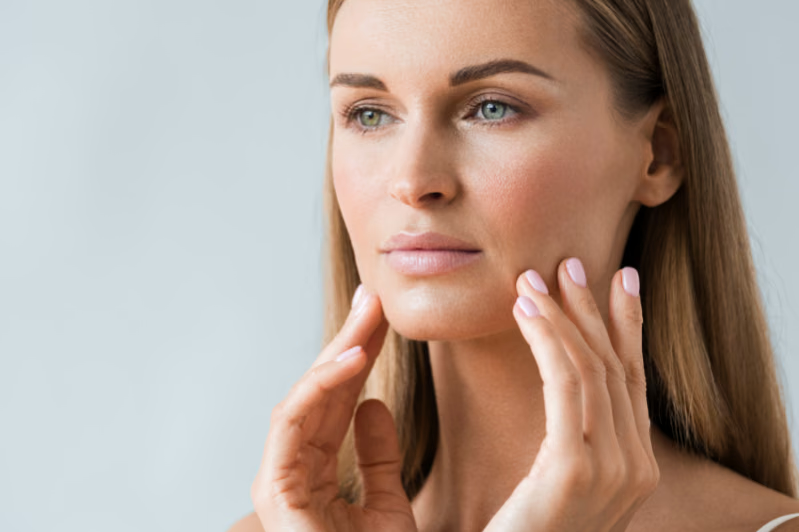
Bichectomy, or buccal fat removal, removes part of the buccal fat pad deep in the cheek through an incision inside the mouth. It aims to reduce fullness of the lower cheek and to make the cheekbones and jawline more defined. There is no external scar.
This page explains what bichectomy is, who it may suit, how the procedure is performed, what recovery involves and the points to bear in mind before deciding.
What is bichectomy?
The buccal fat pad is an encapsulated pad of fat in each cheek, lying between the chewing muscles. In some people it is prominent and produces a rounded fullness of the lower cheek even when they are slim.
In bichectomy the part of the fat pad that faces the mouth is removed through a small incision in the lining of the cheek. Published reviews describe it as an established technique, while stressing that patient selection and the amount removed determine the result.
| Feature | Bichectomy |
|---|---|
| Incision | Inside the mouth, in the cheek lining at the level of the upper molars |
| External scar | None |
| Tissue removed | Part of the buccal fat pad |
| Duration | Permanent |
| Effect | Slimmer lower cheek, more defined facial contours |
| Not suitable for | Slim, thin faces; older patients; those prone to sagging |
Who is a candidate?
- People with marked lower-cheek fullness that is independent of weight
- Those who want more defined facial contours
- People with good skin quality and no facial sagging
- People in good general health who do not smoke
The procedure may not be advised in the following situations:
| Situation | Reason |
|---|---|
| A slim, thin facial structure | Fat removal can lead to a hollow appearance |
| Age-related sagging of the cheek | Loss of volume can make sagging more visible |
| Previous fat-dissolving injections in the cheek | Altered tissue planes can make the procedure more difficult |
| Oral infection, uncontrolled gum disease | Risk of infection |
How is the procedure performed?
Bichectomy is performed under local anaesthesia, with light sedation if wished. It takes 30–45 minutes for both sides.
- Anaesthesia: the cheek lining is numbed with local anaesthetic.
- Incision: an incision of about 1 cm in the inner cheek at the level of the upper molars.
- Reaching the fat pad: the muscle fibres are gently separated to find the capsule of the fat pad.
- Fat removal: the part of the pad that comes forward into the mouth is removed in a controlled manner; the amount is compared on both sides to keep symmetry.
- Closure: the incision is closed with dissolving sutures.
- Bandage: a compression facial bandage may be recommended for a few days.
Because the duct of the salivary gland and branches of the facial nerve lie in this area, the procedure respects the anatomical boundaries.
Planning a visit from abroad
| Step | When | What happens |
|---|---|---|
| First contact | Weeks before | Photographs from the front and at an angle; preliminary opinion |
| Arrival and consultation | Same day or 1 day before | Assessment of facial fat distribution and skin quality, informed consent |
| Procedure | Day 0 | Local anaesthesia; discharge the same day |
| Follow-up | Days 1 – 2 | Wound check |
| Departure | Day 3 – 4 | Flying is possible after the check |
| Remote follow-up | Weeks 2 – 16 | Photographs at agreed intervals |
What does recovery look like?
The times below are typical ranges; they vary between individuals and are not a personal guarantee.
| Period | What to expect |
|---|---|
| First 48 hours | Cheek swelling, mild pain on chewing; cold compresses and a soft diet |
| Days 2 – 4 | Return to desk work for most patients |
| Weeks 1 – 2 | Dissolving sutures dissolve; swelling starts to subside |
| Weeks 3 – 4 | Most of the swelling has settled |
| Months 2 – 4 | Final cheek contour settles |
Attention to oral hygiene, use of an antiseptic mouthwash and avoiding hot and hard foods in the first days are recommended.
What are the risks?
The list below is not exhaustive; individual risks are discussed at the consultation and during the informed-consent process. A review of bichectomy complications reports that most problems relate to patient selection and technique.
- Bleeding and blood collection (haematoma)
- Infection, abscess inside the mouth
- Injury to the salivary gland duct
- Temporary weakness of the cheek branch of the facial nerve
- Asymmetry, under- or over-removal
- Hollowing of the cheek in later life
- Rarely, infection spreading to neighbouring areas
How is the decision made?
At the consultation the overall fat distribution of the face, whether the lower-cheek fullness comes from the buccal fat or from subcutaneous fat, skin quality and any tendency to sagging are assessed. Age and facial structure are considered with future volume loss in mind.
If the fullness is due to buccal fat and the facial structure is suitable, bichectomy can be considered; if a more defined jawline is also wanted, it can be planned together with jawline filler.
The information on this page is for general guidance only and does not replace a medical consultation. Whether bichectomy is suitable for you can only be determined after an in-person examination.